AI-POWERED SCHEDULING
Eliminating Tabulation Friction in Competitive Public Speaking

Transform traditional lesson materials (PDFs and DOCs) into an engaging, interactive, and gamified learning experience for mobile web users.
The problem statement
Traditional learning methods, especially those relying on static PDFs and documents, often fail to engage learners, leading to low retention, motivation, and comprehension. Many learners struggle with passive reading, lack of interactive feedback, and minimal engagement in self paced studies. LearnlyApp aims to bridge this gap by transforming lesson materials into a gamified, interactive, and adaptive learning experience, making studying more engaging, personalized, and effective for users.
Understanding the Problem
Before exploring the design process, I wanted to understand the challenges learners face when studying from static documents like PDFs and Word files. Research in educational psychology highlights that active recall, immediate feedback, and gamification significantly enhance learning outcomes To design an effective solution, I needed to address these core issues—lack of engagement, limited feedback, low motivation, and scope drift in AI-generated content—while ensuring learning remains structured, interactive, and rewarding.
This process primarily involved research and interview to understand users pain point
Primary Research
To better understand learners' challenges with studying from static documents, I conducted Q&A sessions, user interviews, and peer reviews with close friends who are students and rely on PDFs and text-based materials. During these research phase, I also tried to understand
- How engaging or boring static documents feel
- The impact of interactivity on retention and motivation
- How quickly and efficiently users want content converted
- Issues with AI-generated content going off-topic
- What would make users return daily (streaks, leaderboards, adaptive challenges)
Secondary Research
I explored how people stay motivated while studying and how engagement-driven learning improves retention. After gathering insights from interviews and discussions, I identified key principles that enhance learning habits:
- Start with incredibly small habit Incremental improvement daily delivers better results
- Breaking habits into chunks, increase chances to achieve goal
- Never miss your target twice
- Being Patient and consistent with efforts
- Motivational push from peers leads to encouragement and boost in moral



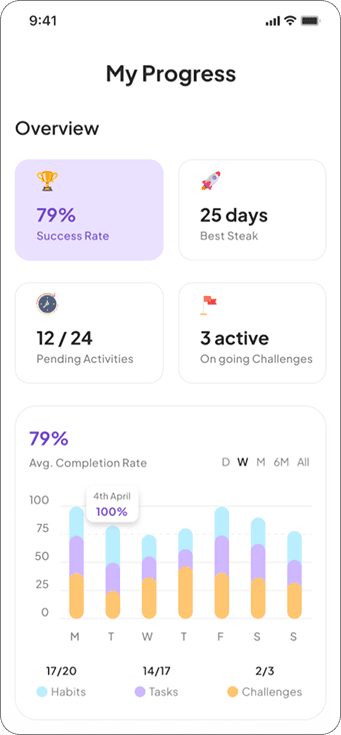
I began by wireframing the 'Habit Loop'—the core interaction where students move from a learning challenge to a reward. Following Donna Lichaw’s Narrative Framework, I treated the wireframe stage as a way to map the user’s emotional journey, ensuring that gamification elements like 'Progress Streaks' were strategically placed at moments of high friction to sustain motivation. By keeping these layouts lo-fi, I was able to stress-test the Information Architecture without the bias of visual aesthetics, ensuring the 'Learning Path' was intuitive and free of cognitive overload


High drop-off at the payment gateway (40% churn). The UX Challenge: > "Learnly faced a critical friction point: users were interested in the content but abandoned the journey at the point of financial commitment. The challenge was to bridge the Engagement Gap—transforming a cold, transactional checkout into a gamified 'Enrollment Experience.' I had to simplify complex course data and introduce behavioral triggers that turned a daunting learning path into an achievable series of milestones.
The transition to high-fidelity was driven by the need for Dopamine-driven Feedback. I utilized high-saturation color contrasts (referencing Johannes Itten’s Saturation Contrast) to make achievement badges and progress bars feel visceral and rewarding. Every visual element was built using an Atomic Design System, ensuring that the gamified 'Organisms'—like the Interactive Quiz and Reward Modal—remained consistent and scalable. The final UI isn't just a learning tool; it is a high-performance ecosystem designed to bridge the gap between education and entertainment."